
$37.8 billion—the largest AI chip IPO in history!
On May 15,U.S. AI chip designer Cerebras Systems successfully listed on the Nasdaq. The initial public offering was priced at $185 per share, raising $5.55 billion (approximately 37.8 billion yuan).This marks the largest IPO since 2026, surpassing Arm Holdings’ 2023 record of $5.23 billion.
According to filing documents, based on shares outstanding, Cerebras’ market capitalization reached $67 billion (approximately 456.1 billion yuan); when including restricted stock, options, and warrants, the fully diluted market capitalization is approximately $83 billion.
The company’s revenue for 2025 was $510 million (approximately 3.5 billion yuan), a year-over-year increase of 76%, with net income reaching $238 million (approximately 1.6 billion yuan). Hardware revenue accounted for approximately 70% of total revenue, while cloud services and other services accounted for nearly 30%.

Image credit: Reuters
Founded in 2015 by Andrew Feldman, Sean Lie, and others, Cerebras is dedicated to revolutionizing traditional AI computing through its Wafer-Scale Engine (WSE), which integrates hundreds of thousands of computing cores onto a single chip, thereby significantly accelerating processing speeds.
Unlike traditional GPU systems that rely on interconnected chip clusters, Cerebras uses the entire silicon wafer directly as a processor, enabling high-throughput AI inference.
As early as 2017, while leading OpenAI, Musk considered acquiring Cerebras and planned to have OpenAI collaborate with Tesla to complete the deal, but the proposal was rejected by Cerebras’ founding team.
Today, OpenAI is already utilizing Cerebras wafers and released its first model running on a Cerebras chip in February of this year.
According to filing documents, the two parties reached an agreement earlier this year under which OpenAI received 33.4 million Cerebras stock warrants. A portion of these warrants is subject to vesting conditions tied to the progress of computing power delivery and whether Cerebras’ market capitalization exceeds $40 billion.

Image source: Bloomberg
Cerebras' chips are designed at the wafer level, meaning the entire silicon wafer is used to create the processor rather than being cut into smaller chips.
In August 2019, the first wafer-level chip, the WSE, made its debut. Dubbed the “world’s largest chip,” it measured 46,225 mm² and was manufactured using TSMC’s 16nm process, integrating 400,000 AI cores and 1.2 trillion transistors.
Currently, Cerebras has launched its third-generation wafer-level AI chip, the WSE-3, which uses a 5nm process technology. On the same 46,225 mm² area, it integrates 4 trillion transistors, features 900,000 computing cores, 44GB of on-chip memory, and delivers up to 21PB of memory bandwidth—an area 58 times larger than that of NVIDIA’s B200.
Compared to the B200 package, which contains two separate chips, the WSE-3 boasts 19 times the number of transistors, 250 times the on-chip memory capacity, and 2,625 times the memory bandwidth.
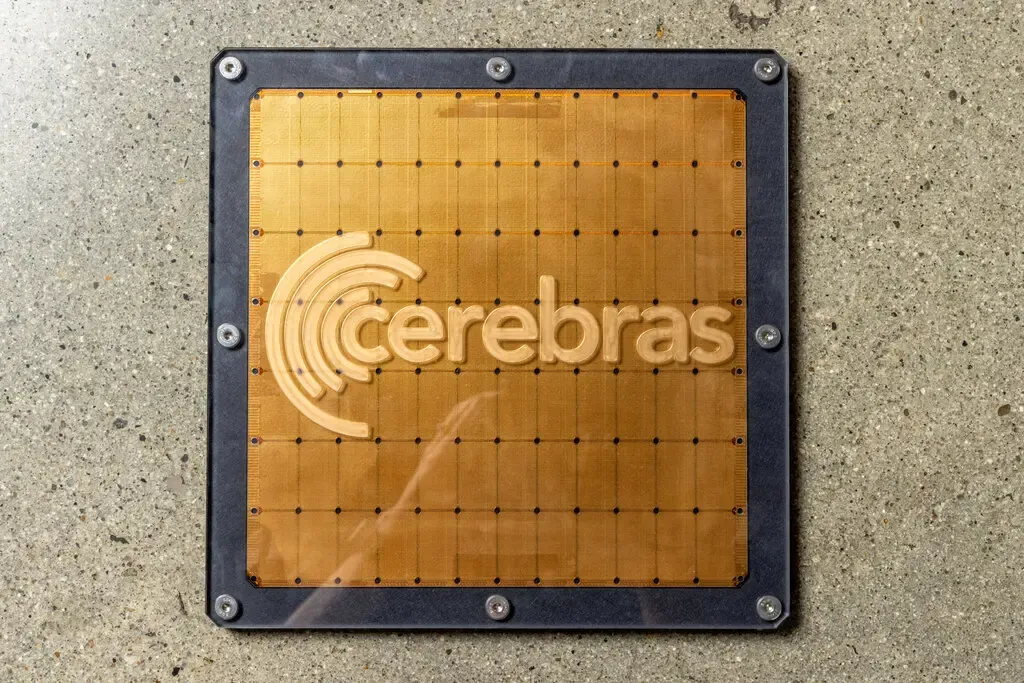
Image source: Cerebras
The WSE chip is manufactured by TSMC, with packaging and testing handled by ASE using specialized processes, and final wafer packaging, assembly, and testing completed at Cerebras’ facility in California.
Cerebras’ investors include chip giants such as Qualcomm, AMD, and TSMC; 1789 Capital, in which Donald Trump’s eldest son is involved; and prominent entrepreneurs such as OpenAI co-founder and CEO Sam Altman, Intel CEO Li-Hua Chen, and Quora co-founder and CEO Adam D’Angelo.
Its clients include OpenAI, AWS, the UAE tech company G42, and the UAE’s Mohammed Bin Zayed University of Artificial Intelligence (MBZUAI), demonstrating its widespread application and market recognition in the fields of AI training and inference.
Note: Calculated at an exchange rate of 1 USD ≈ 6.8078 CNY. Source: Cerebras, Reuters, Bloomberg